
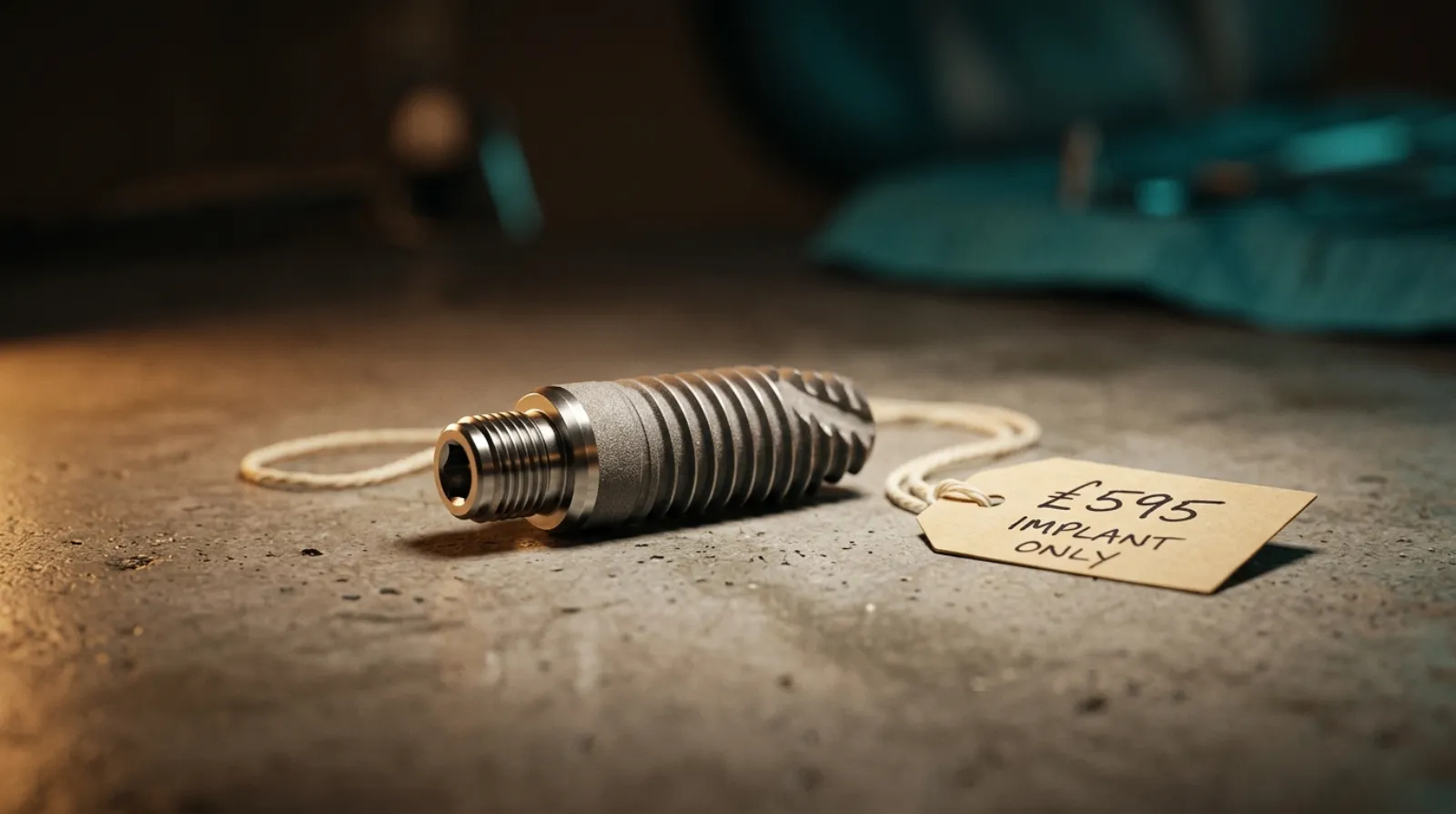
Walk down Avenida A in Los Algodones, Mexico, and the price boards read like a medical-tourism fever dream. "Single titanium implant — $750." "All-on-4 — $7,500." "Free consultation, free X-ray, free shuttle from Yuma." The same surgery in Phoenix, an hour up the road, would cost a US patient $3,500 to $6,000 — sometimes more. So is the Mexico number real?
Mostly, yes. But the headline price is the start of the conversation, not the end of it. After interviewing patients, comparing fee schedules from a dozen clinics, and reading the small print on warranty terms, here is what every American shopping for an implant abroad should know.
Why the price difference is real
It is tempting to assume the gap is explained by quality — that Mexican implants are simply cheaper because they are worse. That assumption usually does not survive a clinic visit. The dental schools that supply Algodones (UABC Tijuana, UNAM, Anáhuac) train surgeons to international standards. The implants on the table are often the same German and Swiss brands a US dentist would use: Straumann, Nobel Biocare, BioHorizons, MIS.
The price gap is mostly structural:
- Labor cost: a Mexican implantologist earns roughly 15–25% of a US counterpart, because Mexican wages are lower across the economy, not because their training is shorter.
- Real estate: a 6-operatory clinic in Los Algodones costs a fraction of an equivalent space in San Diego or Yuma.
- Malpractice insurance: in Mexico, a dentist's annual premium is about $1,000–$3,000. In the US, it is $5,000–$15,000.
- Volume: clinics in Algodones see 30–60 patients a day. US private practices see 8–20. Higher volume means lower per-patient overhead.
- Regulatory and administrative load: Mexican clinics face less HIPAA, less insurance billing, fewer compliance staff.
What is — and is not — in a $750 quote
The most common surprise on a Mexican dental bill is not that it is higher than the quote. It is that the patient assumed the quote covered things it never did. A typical $750 "single implant" in Los Algodones usually includes:
- Implant body (the titanium screw)
- Surgical placement
- Local anesthesia
- Follow-up sutures and one post-op check
It usually does NOT include:
- Abutment ($150–$300): the connector piece that links the implant to the visible crown.
- Crown ($350–$700): the porcelain or zirconia tooth that goes on top.
- Bone graft ($300–$700): if your jawbone is too thin, which is common in patients who lost the tooth long ago.
- Sinus lift ($600–$1,200): if the upper-jaw bone is too short for the implant.
- CT scan ($80–$150): often needed for surgical planning, sometimes packaged free, sometimes not.
Add it all together and an honest quote for one fully-restored implant in a complex case lands somewhere between $1,400 and $2,400 — still a fraction of US prices, but four to five times the headline number.
| Component | Algodones range | US range | Savings |
|---|---|---|---|
| Implant body + placement | $700–$1,000 | $2,000–$3,500 | ~65% |
| Abutment | $150–$300 | $400–$700 | ~55% |
| Crown (porcelain or zirconia) | $350–$700 | $1,200–$2,500 | ~70% |
| Bone graft (if needed) | $300–$700 | $800–$2,000 | ~60% |
| Sinus lift (if needed) | $600–$1,200 | $1,500–$3,000 | ~55% |
| Total, full restoration, complex case | $1,400–$2,400 | $5,500–$11,000 | 70%+ |
The 5 questions to ask before you wire a deposit
- What brand of implant are you placing? Demand a real answer ("Straumann SLActive" beats "premium European brand"). Note the manufacturer and the diameter.
- Is the abutment included? Is the crown included? If not, what do they cost separately, and on which trip?
- If a bone graft or sinus lift is needed, will you tell me before surgery, or after I'm in the chair? The honest answer is "before."
- What is the warranty, and is it written down? Most reputable clinics offer 1–10 years on the implant body and 1–5 years on the crown — but "warranty" is meaningless if it is verbal.
- Who is the surgeon? What is their cédula profesional? You want a name and a Mexican license number, not a brand.
Are the savings worth the trip?
For a single implant in a simple case (no graft, no sinus lift), a US patient saves roughly $1,500–$3,500 net of travel, hotel, and food. For most people, that crosses the "worth a 3-day trip" line — but it is closer than the headline numbers suggest. If you live within driving distance of Yuma, Tijuana, or McAllen, the math gets unambiguously favorable, because flight cost drops to zero.
For a full-mouth case (4 implants per arch, full prosthesis), the gap is enormous: $7,000–$12,000 in Algodones vs $20,000–$45,000 in the US. Even after a week-long trip, the net savings is $10,000+ for the average patient.
The follow-up question nobody asks
If something fails six months after you fly home, what happens? This is the single most underweighted variable in dental tourism economics. The answer depends entirely on the clinic's warranty policy and your willingness to fly back. Some clinics will cover the replacement implant but not the flight, others will not cover anything if you missed a follow-up. Get this in writing, on letterhead, signed — before you book the surgery.
Done correctly, an implant in Mexico is a $1,500–$2,400 investment that saves you the price of a used car. Done carelessly, it is a multi-trip nightmare. The difference is which questions you asked before, not after.