
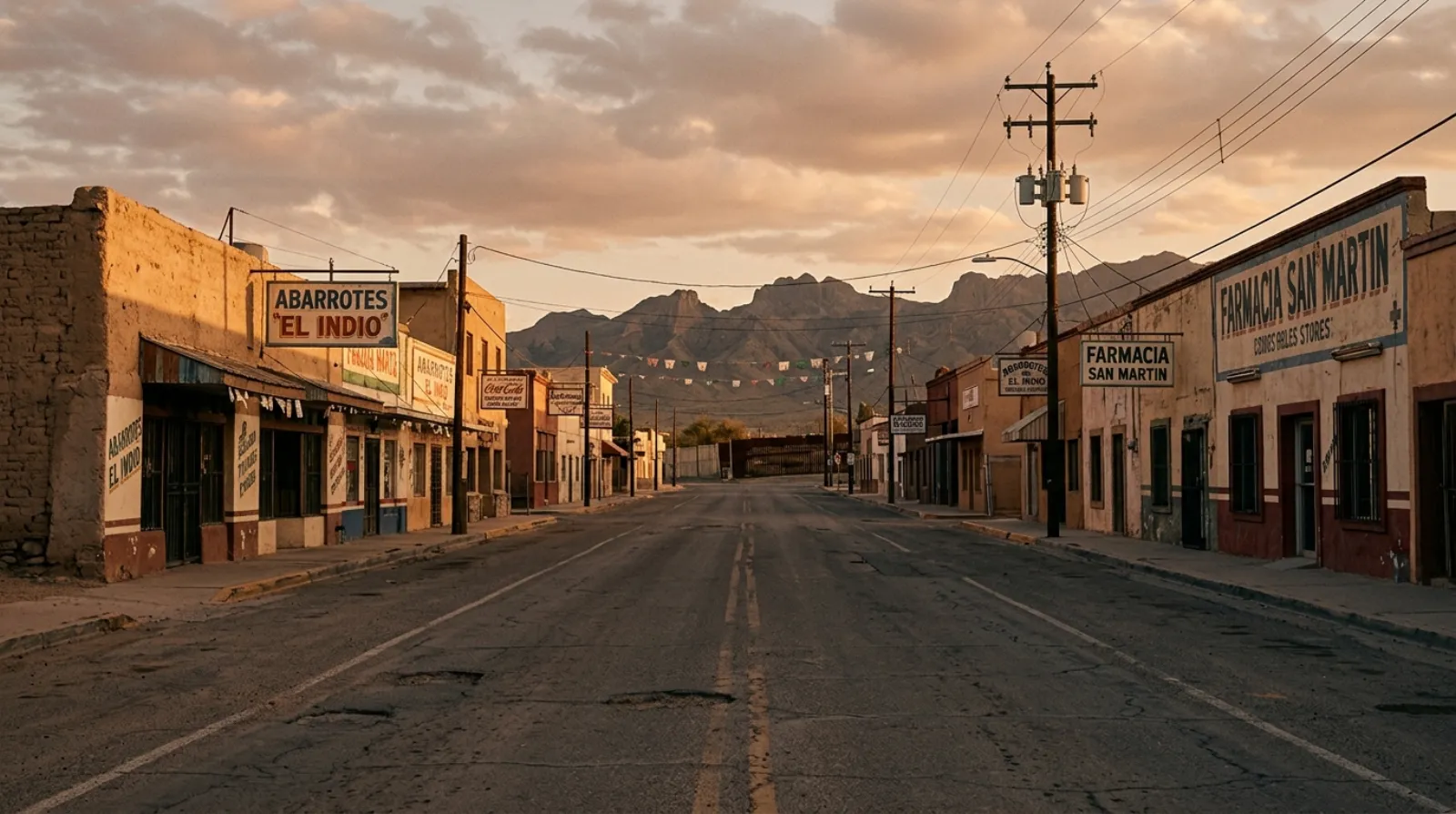
Los Algodones is a town of roughly 5,500 permanent residents in Baja California, Mexico, separated from Yuma County, Arizona by a single border crossing. By every reasonable measure of population density, it has the highest concentration of dentists per capita on Earth: roughly 600 practicing dentists across nine city blocks, or one dentist for every nine residents. The local nickname — "Molar City" — predates the era of cross-border dental tourism, but the math behind it is fully a phenomenon of the last twenty years.
How a single town came to charge half the price of a US dental practice for largely identical work is a story about geography, NAFTA, retiree migration, and a self-reinforcing cluster economy. None of it is an accident.
The geography is the business model
The closest US population center to Algodones is Yuma, Arizona — a city of about 100,000 that swells past 200,000 in winter as snowbirds arrive in their RVs. The closest large dental market on the US side is Phoenix, three hours away. The closest beach is San Diego, four hours. Algodones occupies the only patch of Mexican border within walking distance of an American population in the millions during the winter season.
That geography produced one of the most asymmetric markets in healthcare. On the US side: a dispersed market of retirees on Medicare (which does not cover most dental work), high US dental prices, and few competitors. On the Mexican side: an extremely concentrated market with an instant feedback loop of word-of-mouth referrals. A single bad clinic in Algodones gets known across all of Yuma's RV parks within two weeks.
How NAFTA made Algodones inevitable
Before 1994, Algodones had a small dental market serving the local Mexican population and a trickle of curious American patients. Three changes after the North American Free Trade Agreement reshaped the industry:
- Implant manufacturers (Straumann, Nobel Biocare) opened Mexican distribution centers, dropping the wholesale price of premium implants for clinics south of the border to within ~10% of the US wholesale price — meaning the implant in your jaw is, in most cases, identical to one in San Francisco.
- Mexican dental schools — UABC Tijuana, UNAM, Anáhuac — expanded specialty programs (implantology, prosthodontics, endodontics) that produced surgeons trained on the same protocols and the same equipment as their US peers.
- Cross-border insurance plans (most notably Delta Dental's PPO Mexico extension and several Blue Cross marketplace add-ons) began reimbursing care delivered in Mexico, removing a friction layer for older Americans on supplemental dental policies.
The cluster effect
Once a critical mass of clinics formed in Algodones — roughly 100 by 2005 — the market began to feed itself. Specialty labs (porcelain ceramists, zirconia mills, surgical guide printers) opened to serve the cluster. Suppliers (consumables, sterilization equipment) found it profitable to put representatives on the ground. Surgeons who trained in Tijuana or Mexico City could now move to Algodones knowing the patient flow was expected.
By 2020 there were over 350 clinics. By 2026, north of 600. The town now hosts more dental laboratories per capita than any city in North America, and the labs themselves drive prices down — porcelain crowns that cost $700 to fabricate in Los Angeles cost $80 to fabricate three blocks from where they are placed.
| Year | Clinics in Algodones | Average single-implant price | US average single-implant price |
|---|---|---|---|
| 2000 | ~25 | $1,200 | $2,800 |
| 2010 | ~150 | $950 | $3,400 |
| 2020 | ~400 | $850 | $4,200 |
| 2026 | ~600 | $750–$950 | $3,500–$6,000 |
Quality dispersion is the real story
The honest critique of Algodones is not that the average clinic is bad — it isn't — but that the variance is wide. The top quintile of clinics rivals any practice in San Diego. The bottom quintile is dangerous. The market does not, by itself, surface that distinction; word-of-mouth among RV-park retirees does, but slowly.
Dental boards on the Mexican side (Comisión Nacional de Arbitraje Médico, the CONAMED) handle complaints, but their actions are not searchable in English by default. Cross-referencing with the Mexican federal cédula registry (CONACyT) is the closest thing to a US state-board lookup, but most American patients do not know it exists.
Will it last?
The price gap is structural, not promotional. Mexican wages are not catching up to US wages quickly enough to close it. Implant manufacturer pricing is not converging. The volume of US patients is, if anything, growing — the percentage of Americans without dental insurance has held steady around 30% for a decade, and US dental list prices keep rising.
What could disrupt Algodones is not pricing pressure. It is regulation: a US state Medicaid program deciding to reimburse cross-border care directly would actually drive Algodones prices up, by absorbing more of the surplus. Or a major safety incident in a high-profile clinic could trigger an English-language news cycle that scares away the conservative end of the market. Neither has happened. Both could.
Until they do, Molar City is the most efficient dental market in North America, and that efficiency is the whole point. The dentist a mile from Yuma is not a worse dentist than the one a mile from Phoenix. They are the same dentist, with a different overhead.